
Originally posted on Data Center POST.
Insights from Structure Research, Applied Digital, PowerHouse Data Centers, and DataBank
A New Era of Infrastructure Growth
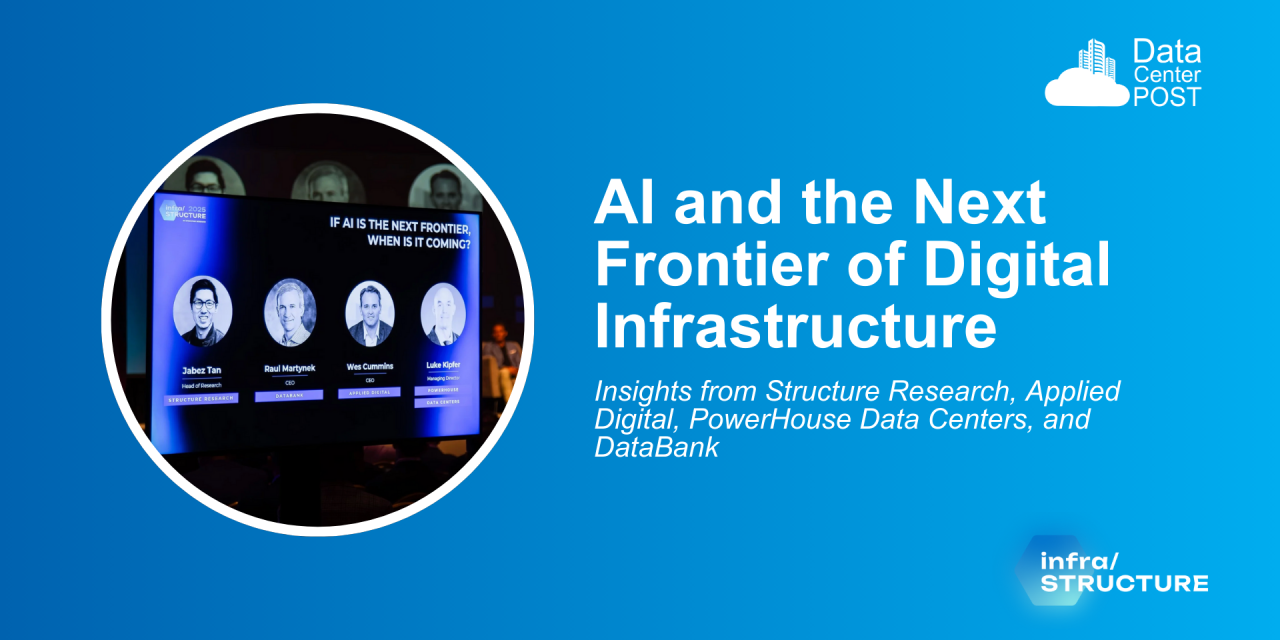
At the infra/STRUCTURE Summit 2025, held October 15–16 at the Wynn Las Vegas, the session titled “AI: The Next Frontier” brought together data center leaders to discuss how artificial intelligence is reshaping infrastructure demand, investment, and development strategy.
Moderated by Jabez Tan, Head of Research at Structure Research, the conversation featured Wes Cummins, CEO of Applied Digital; Luke Kipfer, Managing Director at PowerHouse Data Centers; and Raul Martynek, CEO of DataBank. Each offered unique perspectives on how their organizations are adapting to the acceleration of AI workloads and what that means for power, scale, and capital in the years ahead.
Industry Transformation – From Hyperscale to AI-Scale
Jabez Tan opened the discussion by reflecting on how quickly the market has shifted. Just one year ago, many were questioning the durability of AI-related infrastructure investments. Now, as Tan observed, “The speed of change has outpaced even the most optimistic expectations.”
Wes Cummins of Applied Digital illustrated this evolution through his company’s own transformation. “We started building Bitcoin data centers,” Cummins said. “We were never a miner, we just built the facilities. Then, when AI took off, we realized our designs could scale. We pivoted early, and when ChatGPT hit, the entire world changed.”
That pivot positioned Applied Digital to become a key player in the new era of high-performance computing (HPC) and GPU-intensive workloads, with facilities like its large-scale campus in North Dakota exemplifying how traditional models have been re-engineered for AI.
Building for Scale – Meeting the Demand Wave
Raul Martynek of DataBank and Luke Kipfer of PowerHouse Data Centers both emphasized how scale and speed have become the defining factors of success. “As an executive developer, you have to have the conviction to bring inventory to market,” Martynek said. “If you’re building in good markets and with the right customers, there’s enormous room for growth.”
Cummins agreed, stressing that the conversation has shifted beyond simply securing power. “We’re moving past the question of who has power,” Cummins said. “Now it’s about who can build at scale, deliver reliably, and operate efficiently. Construction timelines, supply chain access, and delivery speed are the new gating factors.”
The panelists noted that hyperscalers are no longer alone in this race. New AI-focused firms, GPU as a service providers, and cloud entrants are competing for capacity at unprecedented levels, pushing the industry to think and build faster.
To continue reading, please click here.
